
The ICD-10-CM code for nephrolithiasis is used to document and bill for kidney stone disease, a common urologic condition. Accurate ICD-10 coding is essential for medical billing, reimbursement, clinical documentation, and data reporting. Errors or vague coding can lead to claim denials, delayed payments, or compliance risks.
This guide explains the correct ICD-10-CM codes for nephrolithiasis, along with coding rules, documentation tips, and billing considerations.
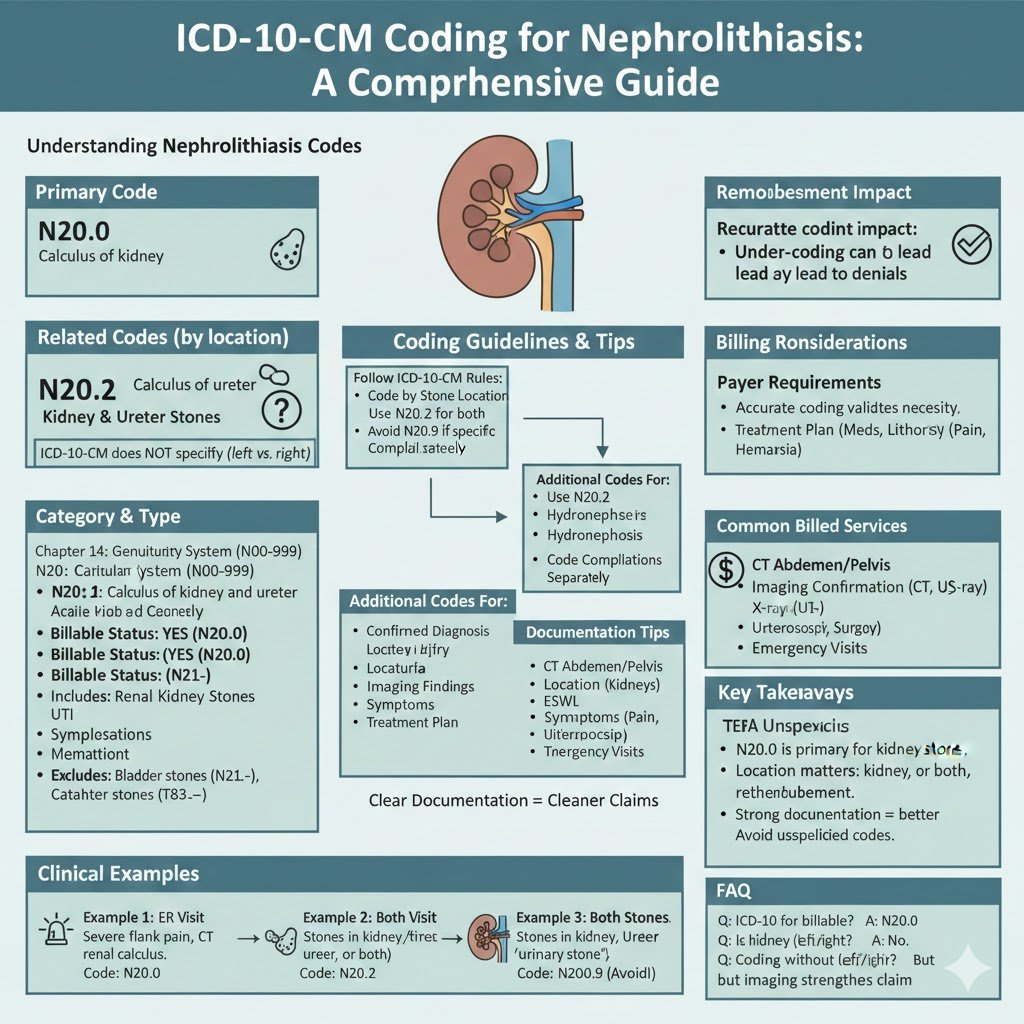
ICD-10 Code Description
Primary ICD-10-CM Code for Nephrolithiasis
Nephrolithiasis refers to the formation of calculi (stones) in the kidney.
Primary code:
-
N20.0 – Calculus of kidney
Related ICD-10 Codes
Depending on stone location, additional codes may apply:
- N20.1 – Calculus of ureter
- N20.2 – Calculus of kidney with calculus of ureter
- N20.9 – Urinary calculus, unspecified
Important: ICD-10-CM does not specify laterality (left vs. right kidney) for nephrolithiasis codes.
Category & Code Type
ICD-10-CM Chapter
-
Chapter 14: Diseases of the Genitourinary System (N00–N99)
Code Category
-
N20 – Calculus of kidney and ureter
Billable Status
- N20.0 is a billable and specific ICD-10-CM code
- Valid for diagnosis reporting in all healthcare settings
Includes / Excludes Notes
Includes:
- Renal calculi
- Kidney stones
Excludes:
- Bladder stones (N21.-)
- Calculus due to indwelling urinary catheter (T83.-)
Coding Guidelines
When coding nephrolithiasis, follow these ICD-10-CM rules:
- Code based on stone location (kidney, ureter, or both)
- If both kidney and ureter stones are present, use N20.2
- Do not code unspecified calculi if documentation supports a more specific code
- Code additional complications separately (e.g., obstruction, hydronephrosis, infection)
Additional Codes May Be Required For:
- Acute kidney injury
- Hydronephrosis
- Urinary tract infection
- Hematuria
- Pain management encounters
Billing Considerations
Reimbursement Impact
- Accurate coding supports medical necessity for imaging, procedures, and urology consults
- Under-coding or unspecified codes may trigger payer denials
Payer Considerations
-
Many payers require:
-
Imaging confirmation (CT, ultrasound, X-ray)
-
Symptom documentation (pain, hematuria, obstruction)
-
Treatment plan (medication, lithotripsy, surgery)
-
Commonly Billed Services with N20.0
- CT abdomen/pelvis
- Ultrasound kidneys
- ESWL (lithotripsy)
- Ureteroscopy
- Emergency department visits
Documentation Tips
To support accurate ICD-10 coding for nephrolithiasis, ensure documentation includes:
- Confirmed diagnosis of kidney stone
- Stone location (kidney vs. ureter)
- Imaging findings
- Symptoms (renal colic, hematuria, nausea)
- Complications, if present
- Treatment plan or intervention
Clear documentation = cleaner claims and faster reimbursement.
Common Clinical Examples
Example 1: Emergency Visit
A patient presents with severe flank pain. CT scan confirms a renal calculus.
-
Correct code: N20.0
Example 2: Kidney and Ureter Stones
Imaging shows stones in both kidney and ureter.
-
Correct code: N20.2
Example 3: Stone Location Not Documented
Provider documents “urinary stone” without specifying location.
-
Code used: N20.9 (not ideal—clarification recommended)
Common Errors & Denials (Optional)
- Using N20.9 when imaging specifies kidney stones
- Failing to code associated complications
- Confusing bladder stones (N21.-) with nephrolithiasis
- Missing clinical support for imaging or procedure
Key Takeaways
- N20.0 is the primary ICD-10-CM code for nephrolithiasis (kidney stones)
- Always code to the highest level of specificity
- Location matters: kidney, ureter, or both
- Strong documentation improves reimbursement and compliance
- Avoid unspecified codes when details are available
FAQ:
What is the ICD-10 code for nephrolithiasis?
The primary ICD-10-CM code is N20.0 – Calculus of kidney.
Is N20.0 a billable code?
Yes. N20.0 is a billable and valid diagnosis code for reimbursement.
Does ICD-10 specify left or right kidney stones?
No. ICD-10-CM does not include laterality for nephrolithiasis.
What code is used for kidney and ureter stones together?
Use N20.2 – Calculus of kidney with calculus of ureter.
Can nephrolithiasis be coded without imaging?
Clinical diagnosis may be acceptable, but imaging greatly strengthens medical necessity for billing and payer review.